



On June 2, 2026 for the first time in more than three decades – Beijing’s Public Security Bureau barred the Tiananmen Mothers from setting foot in Wan’an Cemetery to mourn their dead. The ban marks a quiet inflection point: the regime is no longer content to police what is said about June 4, 1989. It now controls who may grieve, where, and in what silence. Thirty-seven years after PLA tanks crushed the Goddess of Democracy at dawn, the apparatus of forgetting has evolved from rifles and propaganda dailies into an algorithmic ecosystem that scrubs candle emojis, blocks the digits “62+2,” and trains chatbots to dodge the date of their own existence. Yet on the same June 3, 2026 evening, a Hong Kong performance artist was searched in Causeway Bay for trying to display a 6.4-metre red string, and in Taipei, plans were laid to light another year of digital candles for “64 seconds of silence.” Memory persists in the precise measure that the state escalates to suppress it.
What the 37th Tiananmen Massacre anniversary actually looks like in 2026
The cemetery ban – reported as an exclusive by Radio Free Asia on June 2, 2026 is unprecedented since the Mothers began their annual visits in the early 1990s. Zhang Xianling, 88, told RFA the police chief himself joined the surveillance detail outside her home on May 28, two uniformed officers, two plainclothes, one marked car, one unmarked. “They won’t let us go to Wan’an Cemetery now, nor will they let us read sacrificial texts or eulogies,” she said. “Something that has never happened before.” In December 2025, authorities had already broken precedent by disrupting the Mothers’ annual New Year gathering – a tradition since 2009.
The group’s May 27, 2026 commemoration statement, distributed by Human Rights in China, was signed by 107 living members and appended with 80 deceased signatories. The 2025 letter had 108 living and 79 deceased. The arithmetic of attrition is the regime’s preferred ally: founder Ding Zilin, who will turn 90 in December, has had multiple falls, broken ribs, lingering damage from COVID. Zhang Xianling has become the de facto spokesperson because, as she put it, “I am currently the only one able.” The Mothers’ confirmed death list has been frozen at 202 names since August 2011 – not because the killing stopped at that number, but because witnesses are dying and survivors are too frightened to come forward. The youngest victim they have documented was nine years old.
Across Beijing, Shanghai, Chengdu, Hunan, and Hubei, state-security officers contacted dissidents in late May 2026, warning against VPN use, foreign media contact, and any gathering – the now-routine “stability maintenance” choreography. Journalist Du Bin, who had published a book on the massacre, has been held at Shunyi Detention Centre since October 2025, charged in December with “picking quarrels” for books that “attack national leaders.”
From Rifles to MD5 hashes: the architecture of erasure
In 1989, suppression was kinetic: tanks, dum-dum bullets, the banning of World Economic Herald, the parading of “counter-revolutionary” student leaders on state TV. The Golden Shield Project, launched in 1998, brought IP blocking and crude keyword filters. By September 2002, the OpenNet Initiative documented a leap in sophistication – DNS poisoning, deep packet inspection. Sinologist Geremie Barmé had already coined the term “Great Firewall” in 1997.
What followed was a steady migration from blunt censorship to predictive moderation. Harvard’s King-Pan-Roberts studies (2013, 2014, 2017) found that Chinese censors don’t target criticism of officials so much as anything with collective-action potential: more than half of submitted posts on sensitive topics are removed within hours, often by an estimated 250,000–300,000 “50 Cent Party” posters flooding the zone. Citizen Lab’s Jeffrey Knockel demonstrated in 2018–2019 that WeChat silently filters images by MD5 hash and visual-similarity matching — sensitive pictures are blocked in private one-to-one chats before the recipient sees them, with no notice to sender or recipient.
By 2025 the censorship was generative. DeepSeek R1, released January 20, 2025, begins answering questions about “the famous picture of a man with grocery bags in front of tanks” “The famous picture you’re referring to is known as ‘Tank Man’ or ‘The Unknown Rebel.’ It was taken on June 5, 1989…” then deletes its own answer mid-sentence and substitutes: “Sorry, that’s beyond my current scope. Let’s talk about something else.” Stanford-Princeton testing by Pan & Xu found DeepSeek refused 36% and Baidu’s Ernie Bot 32% of 145 political questions; Western models refused under 3%.
A 230-page cache of leaked Chinese platform documents reported by ABC Australia in 2025 revealed an internal moderation policy spelled in four words: “Delete first. Review later.” Tank Man imagery is targeted by name; even “one banana in front of four apples in a line” was flagged by image-recognition algorithms as a Tank Man analog.

The dictionary of forbidden language has grown grotesquely creative. “五月三十五日” (May 35th) is blocked. So is “VIIV” (Roman numerals for 6/4), “8²”, “63+1”, “62+2” (added in 2024), and “0.64 RMB” WeChat Pay transfers on June 4, 2025 (0.63 RMB went through fine). Candle emojis disappeared from Weibo in early June 2012. The Muxidi subway station has been mysteriously closed for “repairs” every June 4 since 2013. In June 2025, Tencent’s mobile game forced every player’s WeChat avatar to a uniform green penguin; Douyin livestreamers were instructed: “Don’t say the number 64 today, whether it’s for prices, measurements, or product codes.”
The vigil that ended, the trial that replaced it
For thirty years Hong Kong’s Victoria Park hosted the only mass public mourning permitted on Chinese soil — 180,000 people in 2009, an estimated 180,000 again in 2019. The vigil was banned in 2020 on COVID pretext as Beijing was finalizing the National Security Law; thousands defied police and lit candles anyway. The Hong Kong Alliance dissolved itself on September 25, 2021 by a vote of 41 to 4. The “Pillar of Shame,” Jens Galschiøt’s 8-metre copper sculpture installed at the University of Hong Kong since 1997, was dismantled overnight on December 22-23, 2021 the Goddess of Democracy at Chinese University and Chen Weiming’s bas-relief at Lingnan were removed in pre-dawn raids on December 24, 2021. National Security police seized the Pillar as criminal evidence in May 2023.

In 2026, Victoria Park hosts its fourth consecutive “Hometown Market” patriotic food carnival — 370 booths of Guangdong cuisine and tech showcases — running June 3 to 7. Meanwhile, in a courtroom about two kilometres away, Chow Hang-tung, Lee Cheuk-yan, and Albert Ho — the vigil’s organizers — have spent more than 1,600 days in pre-trial detention. Closing arguments in their NSL subversion trial concluded May 18-20, 2026; verdict expected July; maximum sentence ten years. On March 25, 2026, Judge Alex Lee corrected Chow when she said “June 4 massacre,” demanding she use “June 4 incident.” Ho, a former cancer patient, pleaded guilty on January 22, 2026. On June 3, 2026, performance artist Sanmu Chen was stopped for the red string; artist Chan Mei-tung was searched for carrying a question-mark balloon. In 2025, she had been detained for chewing gum.
The killing was on the roads, not in the square
The death toll remains the most contested number in modern Chinese history. Beijing’s official figure has hovered near 200-300 civilians and “several dozen” soldiers. The Chinese Red Cross initially told reporters 2,600 dead on June 4 morning, then retracted under pressure. The Swiss ambassador, touring hospitals, estimated 2,700. In October 2017, the UK National Archives declassified a cable from Ambassador Sir Alan Donald, dated June 5, 1989, citing a State Council source: “Minimum estimate of civilian dead 10,000.” The cable’s detail is unsparing – APCs running over students at 65 km/h to “make pie,” dum-dum bullets, soldiers bayoneting wounded girls, snipers shooting balcony residents and street sweepers “for target practice.” Donald later revised his estimate downward to 2,700-3,400; scholars including Timothy Brook consider 10,000 implausibly high.
The geography matters more than the count. Most killing happened not on Tiananmen Square but along the approach roads — chiefly Muxidi, two miles west on Chang’an Avenue, where the 38th Group Army opened fire on residents in apartment blocks housing senior cadres. A US Embassy cable declassified by the National Security Archive states explicitly: “many if not most of the deaths…occurred on Changan Avenue and other approach roads, not on the Square itself.” The square was largely cleared by negotiation – the Four Gentlemen (Liu Xiaobo, Hou Dejian, Zhou Duo, Gao Xin) brokered the dawn withdrawal with PLA commissars Ji Xinguo and Gu. As students retreated down Liubukou, three tanks from the 38th’s 1st Tank Division accelerated into the column from behind; at least eleven died on the spot, and Fang Zheng lost both legs. BBC’s James Miles acknowledged in 2009 that early Western framing of a “massacre in the square” allowed Beijing a rhetorical escape hatch — “no one died in the square” became literally true and morally absurd.
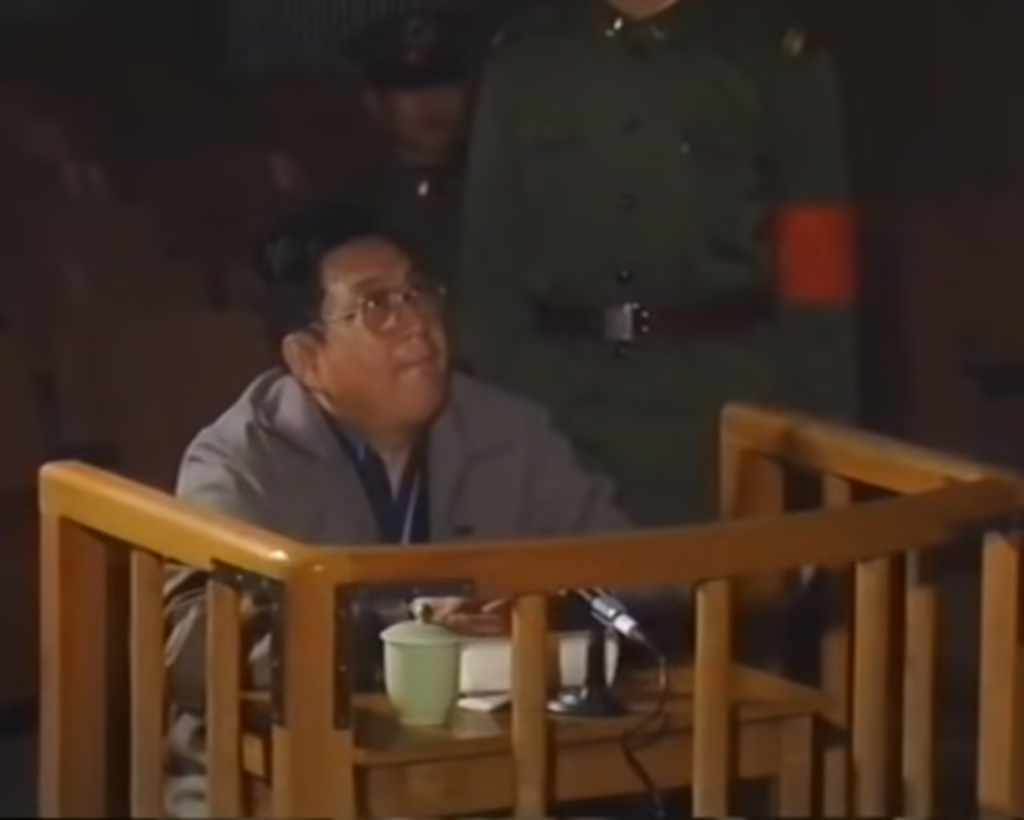
A separate revelation surfaced on November 24, 2025: six hours of leaked footage from the secret 1990 court-martial of Major General Xu Qinxian, the 38th Group Army commander who refused to deploy without a written order. Hospitalized for kidney stones, Xu had watched the hunger strike on TV and wept. “I’d rather be beheaded than become history’s criminal,” he told friends privately. On camera, he stated: “I hoped primarily to resolve the issue by political means…I had doubts about whether acting this way was right or wrong.” He was jailed five years and died in internal exile in 2021. The Tiananmen Mothers cited him by name in their 2026 letter.
Where memory survives: Taipei, New York, a digital exodus
In 2025, roughly 3,000 people gathered at Taipei’s Liberty Square for a 64-second silence — the largest annual Tiananmen vigil now held in any Chinese-speaking polity. President William Lai’s statement called June 4 “a taboo topic in China” while Taiwan “has taken the opposite path.” Many attendees were among the 150,000-plus Hongkongers who have relocated to the UK under the BN(O) visa scheme since 2021, the 200,000-plus who have left Hong Kong altogether, or Taiwan’s growing community of post-2020 émigrés.
The June 4th Memorial Museum — founded by Wang Dan and curated by Zhou Fengsuo after the Hong Kong original was forced shut in June 2021 — opened to the public at 894 Sixth Avenue in Manhattan on June 25, 2023, funded partly by a $120,000 anonymous donation from a mainland participant in 1989. Its exhibits include a blood-soaked banner used to bind bullet wounds and a letter from Liu Xiaobo to Wang Dan. Replicas of the Pillar of Shame now stand in Oslo, Taipei, Prague, Budapest; a model was installed outside the European Parliament in Brussels on March 20, 2024, the same day Hong Kong passed Article 23. Galschiøt waived his copyright in 2021 — anyone may now print the Pillar from open-source 3D files compiled by activists in Hong Kong from 900 photographs.
What young Chinese know and don’t
The success of the suppression is statistical. When journalist Louisa Lim showed the Tank Man photograph to 100 students at four elite Beijing universities for her 2014 book The People’s Republic of Amnesia, only 15 recognized it. Nineteen identified it as a military parade. One asked if it was Kosovo.
Another wrote: “This picture, maybe, is related to a counter-revolutionary incident which was two or three years after my birth.” The event is omitted from mainland high school textbooks, college-level material describes 1989 as evidence that “Western democracy is not suitable for China’s situation.” Hong Kong textbooks dropped Tiananmen content after 2020.
The “Little Pink” generation of online nationalists, roughly 18-24 and skewing female, dismisses commemoration as Western anti-China propaganda when they encounter it at all. But reverse-conversion stories exist. Yang Ruohui, a former Little Pink studying at Humber College in Canada, testified before the Congressional-Executive Commission on China on June 4, 2024, holding up a PLA “Defending the Capital” medal: “What shocked me the most wasn’t that the CCP shot and killed people. What really moved me the most was the freedom and openness of society back in 1989.” A volunteer at the New York museum, identified only as “Dong,” served seven months in a Chinese prison for wearing a T-shirt marking the date.
What endures, and why it matters
The arc bends both ways. China has perfected forgetting to a degree the architects of 1989 could not have imagined – an estimated 600 million cameras (roughly three for every seven people), AI systems that flag bananas with apples as subversive, predictive surveillance that contacts dissidents before they think to act. Yet the regime now reaches further to suppress less.
The Tiananmen Mothers, denied a cemetery visit, still produce an annual letter. Chow Hang-tung, in her sixth year of pre-trial detention, conducts a 36-hour hunger strike from her cell each June. A 6.4-metre red string is enough to mobilize Hong Kong’s national security police.
Thirty-seven years on, the lesson is not that memory has been destroyed but that the cost of remembering keeps rising and that, contrary to the regime’s expectation, people keep paying it. The Goddess of Democracy was crushed within hours of being raised; her open-source replicas now print on demand on six continents. Tank Man’s identity remains unknown – a void the state has filled with denial and AI engineers fill with refusal messages. But the photograph, the four shopping bags’ worth of moral courage it captured, has become the most reproduced image of dissent in history. That is the paradox of the evolution of forgetting: the more sophisticated the apparatus, the more eloquent the residue.


