



In the long and dignified history of the rank of Field Marshal, the criteria have tended to be consistent. You either won a major war (Sam Manekshaw), turned the tide of one (Zhukov, Rommel) or failing that, conquered a country (Napoleon’s marshals, who at least had the courtesy to deliver actual conquests).
Pakistan, in May 2025, pioneered a new category: Field Marshal for asking the other side for a ceasefire after eighty-eight hours.
When Pakistan’s federal cabinet promoted Army Chief General Asim Munir to the rare five‑star rank of Field Marshal just days after the guns fell silent post–Operation Sindoor, it looked less like a victory lap and more like damage control dressed up as glory. The move has since become a symbol of how Pakistan’s power structure prefers narrative over hard battlefield realities.
This is not a partisan framing. It is the publicly admitted sequence of events. On 10 May, Pakistan’s Director General of Military Operations telephoned his Indian counterpart proposing a halt to hostilities. India accepted. Ten days later, the Pakistani cabinet promoted the army chief who had been in charge during those eighty-eight hours to the rank of Field Marshal.
Operation Sindoor: A Painful Jolt

Operation Sindoor was India’s calibrated response to the April 22, 2025 Pahalgam terror attack, in which 26 tourists were killed by Pakistan‑linked militants. New Delhi framed the operation as a limited counter‑terror campaign: precision strikes on nine identified terror camps and related infrastructure in Pakistan and Pakistan‑occupied Kashmir, not a declaration of full‑scale war.
Pakistan tried to answer with a show of force drones, missiles and artillery fire aimed at Indian military and civilian targets along the Line of Control and deeper inside Jammu & Kashmir. But Indian air defence and counter‑drone systems reportedly intercepted most of these attacks, and Islamabad struggled to present credible, independent evidence of major damage inflicted on Indian assets.
Indian briefings later claimed Pakistan had lost over 100 soldiers along the LoC and suffered the destruction of several aircraft, including a transport plane, an AEW&C platform and multiple fighters during the four‑day confrontation. At the same time, fact‑check units in India dismantled a wave of Pakistani disinformation viral videos of “destroyed” Rafales and MiG‑29s turned out to be old or unrelated footage repackaged as Operation Sindoor “proof.”
US analyst John Spencer, Chair of War Studies at the Madison Policy Forum, concluded that India had effectively achieved air superiority within seventy-two hours, with sustained strikes on Pakistani radar systems, missile batteries, and air-defence networks crippling Islamabad’s operational coordination. A January 2026 report from the Swiss Centre d’Histoire et de Prospective Militaires, which reconstructed the campaign from operational data rather than press conferences, attributed multiple Pakistani aircraft losses F-16s and JF-17s to Indian air defences. The report also noted that Pakistani claims of damage to Indian airbases were not supported by satellite imagery, which is a polite way of saying they were not true.
By May 10, it was Pakistan’s DGMO who approached India to seek an understanding to halt further firing and military activity, a detail New Delhi has highlighted repeatedly as evidence of who actually needed the ceasefire more. On the ground, in the air and in the information domain, Pakistan came out of Sindoor looking bruised, not triumphant
The Sudden Field Marshal
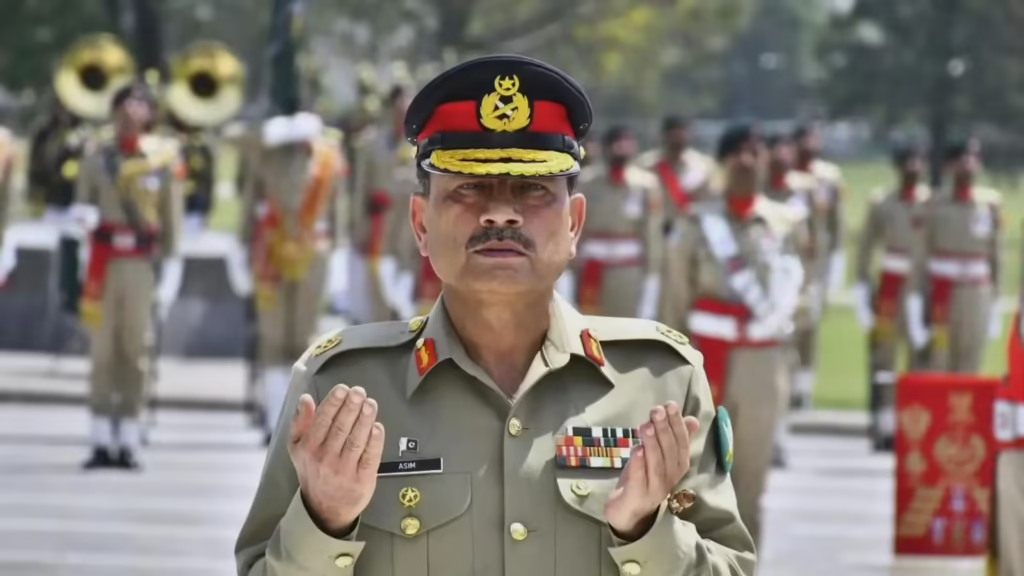
In that context, the announcement on May 20, 2025 landed like a plot twist: Prime Minister Shehbaz Sharif’s cabinet had approved the promotion of General Asim Munir to the rank of Field Marshal, the highest ceremonial rank in Pakistan’s army and one not used in nearly six decades. Only Ayub Khan had worn those five stars before he effectively conferred the title on himself while ruling Pakistan as a military strongman in the late 1950s and 1960s.
Ayub also fought a war with India the 1965 conflict, which he initiated through Operation Gibraltar, a plan to infiltrate Kashmir and trigger a popular uprising. The uprising did not occur. The infiltration was detected. India responded by crossing the international border toward Lahore. The war ended in stalemate, mediated by the Soviet Union at Tashkent. Ayub returned home, was greeted as a hero by the regime’s own media, and was politically finished within four years. Mass protests forced his resignation in 1969. He died in 1974, having presided over the loss of Pakistan’s first major war and the beginning of the political crisis that would lead to the country’s eventual partition in 1971. The pattern, then, has Pakistani precedent: a Field Marshal awards himself or is awarded the rank in connection with a military adventure that did not, on close inspection, go especially well, and is celebrated as a victor until the truth becomes harder to suppress.
Sharif’s office justified Munir’s elevation by praising his “exemplary leadership” and “courageous defence” against India during the recent conflict, claiming that under his command Pakistan’s armed forces had safeguarded national sovereignty and defeated the enemy’s designs. In parallel, the government also extended the tenure of Air Chief Marshal Zaheer Ahmed Babar Sidhu, signalling continuity at the top of Pakistan’s military pyramid.
Formally, this is a cabinet decision on the prime minister’s advice. But in a country where the army has repeatedly toppled elected governments and where the army chief is widely seen as the real kingmaker, many Pakistanis and observers read it as the system rewarding its own regardless of what the battlefield ledger shows.
Optics, Ego and a “Self‑Promotion” Perception
Critics quickly branded the move as a de facto self‑promotion by the military high command after a shaky performance in conflict. Commentators noted the irony: Ayub Khan had elevated himself to Field Marshal after a stalemated 1965 war; Asim Munir receives the same title after a short confrontation in which India claims the upper hand, Pakistan’s aircraft and soldiers are lost, and Islamabad is the side asking for a ceasefire.
Social media mocked Munir as “Failed Marshal” and lampooned the idea of decorating a general whose biggest visible achievement in Sindoor was surviving a political and military embarrassment. Indian and international coverage picked up that tone, describing the promotion as a mix of internal power consolidation and narrative spin rather than a reward for a clear, measurable victory over India.
What It Says About Pakistan’s Leadership
At one level, Munir’s promotion is classic Pakistani civil–military theatre: the civilian government performs the ritual of honouring the army chief, while the deeper message is that the army remains untouchable, its prestige non‑negotiable even after a setback. Field Marshal is a ceremonial rank, but granting it in the immediate aftermath of Operation Sindoor turns a contested episode into state‑sanctioned mythmaking about “brilliant leadership” and “crushing the enemy.”
At another level, it exposes the fragility of Pakistan’s strategic culture. Rather than openly interrogating why a limited Indian punitive operation could extract heavy costs and force Islamabad into seeking a ceasefire in just four days, the leadership has chosen to double down on symbolic elevation and carefully worded victory rhetoric. In doing so, it signals to its own population that preserving the army’s aura matters more than aligning the public story with the actual balance sheet of the battlefield.
For many in the region, that is the real story of Asim Munir’s five stars: not a Field Marshal forged in triumph, but a politically convenient halo placed on a general walking out of a war he could not afford to fight any longer.
If the promotion had been the end of it, one could read it as a face-saving gesture by an embarrassed government the sort of thing nations occasionally do after wars whose results are too painful to acknowledge. Awkward, but not consequential.
But it was not the end of it. In November 2025, six months after the promotion, the 27th Amendment to the Constitution of Pakistan was pushed through both houses of Parliament in five days. The amendment made the Field Marshal rank lifelong. It granted the rank lifelong immunity from criminal prosecution and arrest broader, in scope and duration, than the immunity previously held by the President of Pakistan, which expires when he leaves office. It made the army chief automatically Chief of Defence Forces, formally subordinating the navy and air force. It raised the bar for removing a five-star officer to a two-thirds parliamentary majority, a higher threshold than the simple majority needed to remove an elected prime minister.
Ayub at least conquered his own country. Munir, in the war for which he was promoted, conquered nothing. He was struck, he was reduced to asking the other side to stop, and he was given a five-star rank for it anyway.
The rank exists. The immunity exists. The constitution has been rewritten to accommodate them.
The victory does not.


