


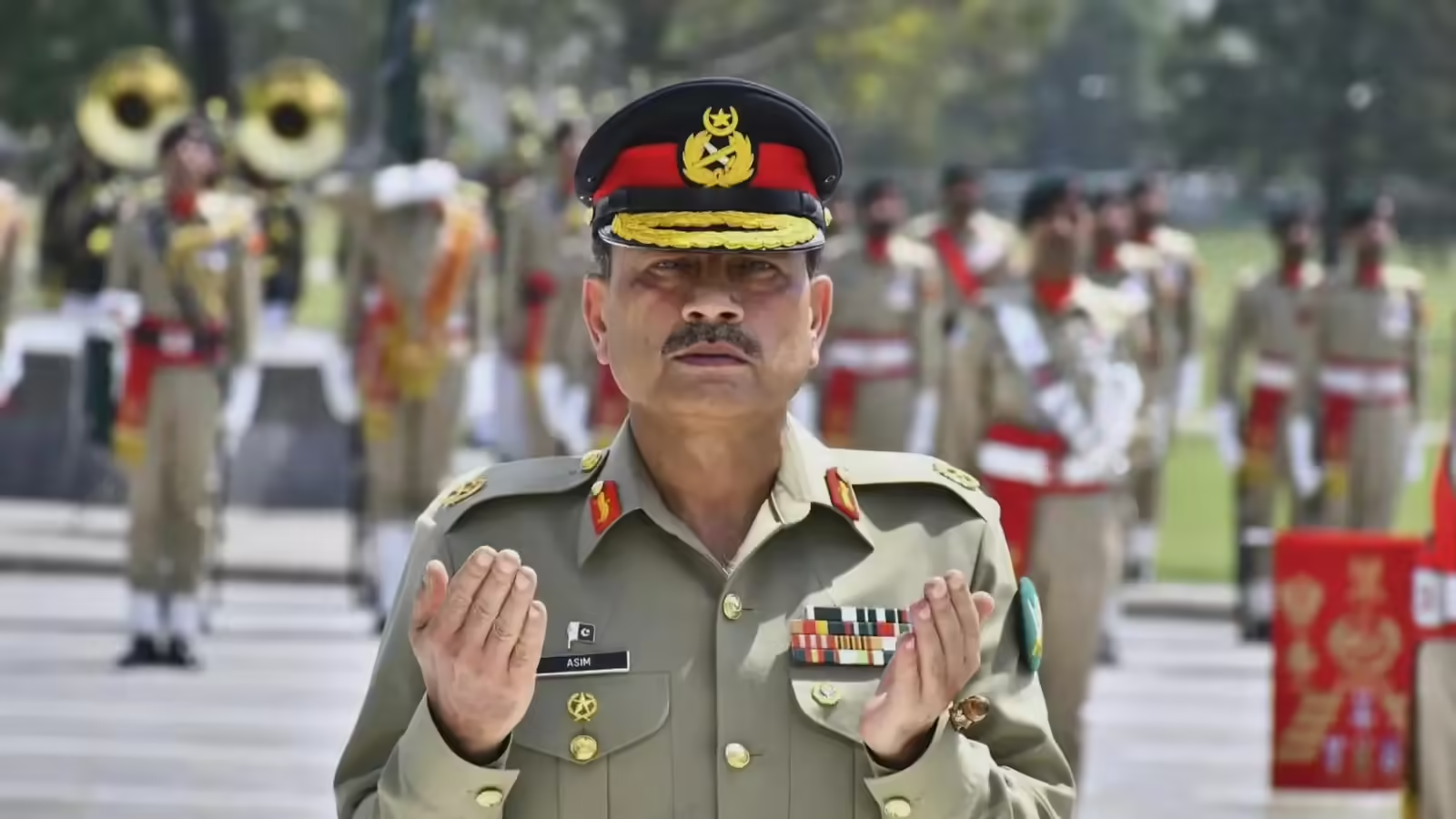
Power often creates its own mythology. The more authority a leader accumulates, the easier it becomes to manufacture an aura of invincibility around him. Pakistan’s military has perfected this art for decades, portraying each successive army chief as the indispensable guardian of the state. Field Marshal Asim Munir is perhaps the latest and most ambitious embodiment of this tradition. His unprecedented elevation to the rank of Field Marshal following the 2025 India–Pakistan crisis reinforced this carefully constructed narrative. Yet beneath this institutional propaganda lies a grim reality. Pakistan today remains trapped in deep political polarization, a bankrupt economy, and the resurgence of militant violence across several provinces. Asim Munir increasingly projects an image of unquestionable authority that critics argue rests more on institutional dominance than demonstrable success. This article examines the background behind Asim Munir, his policies, and the implications of his leadership for Pakistan and India.
ASIM MUNIR: THE DECEIVER
Syed Asim Munir’s ascent to the summit of Pakistan’s military establishment is unusual even by the standards of the Pakistan Army. Born in 1968 and raised in Rawalpindi, Munir joined the Pakistan Army in 1986 through the Officers Training School at Mangla rather than the traditional Pakistan Military Academy (PMA) Kakul, like previous army chiefs. Later, he was commissioned into the 23rd Battalion of the Frontier Force Regiment. Asim Munir is uniquely known as an “intelligence guy” in military circles because he is the first Chief of Army Staff in Pakistan’s history to have previously headed both of the country’s primary spy agencies: Military Intelligence (MI) in 2017 and the Inter-Services Intelligence (ISI) in 2018. In November 2022, he succeeded General Qamar Javed Bajwa as Chief of Army Staff.

Apart from the professional trajectory, there is another dimension to Munir’s personality that has attracted considerably more attention. Within military circles Munir is often nicknamed “the Deceiver” by his peers since his days as a junior officer. The moniker represents the archetype of the calculating military insider—an officer accustomed to operating behind the scenes, reflecting a duplicitous approach. Furthermore, Munir’s background in intelligence also makes this perception particularly potent. Another dimension to Munir’s personality is his religiosity. During his military service in Saudi Arabia, Munir memorized the Quran and became a Hafiz-e-Quran. Munir frequently invokes Quranic verses, Islamic history, and religious concepts when discussing Pakistan’s national identity and security. This combination of military authority and visible religious conservatism has led commentators to describe him as the “Mullah General.” For critics, it raises questions about the increasing fusion of religious ideology with state power.
THE HARD STATE DOCTRINE: MUNIR’S RECIPE FOR CONTROL
Soon after assuming office as the army chief, Munir championed what officials termed a “hard state” doctrine. It refers to a governance philosophy emphasizing centralized authority, aggressive counterterrorism, tighter political control, and an expanded role for the military in national affairs. Under this approach, authorities increasingly view dissent through a security lens, while coercion has taken precedence over political accommodation. The doctrine promised to restore order and eliminate militancy through decisive force. Instead, Pakistan continues to confront mounting security challenges. The danger, however, is that a state becomes so focused on controlling opposition that it loses sight of the grievances driving it.
In Balochistan, where grievances over political representation, resource distribution, disappearances, and security operations have existed for decades, the continued reliance on force has struggled to extinguish the insurgency. Instead, the BLA has demonstrated a capacity to penetrate even heavily secured areas. The same dilemma is visible in Khyber Pakhtunkhwa. The resurgence of the TTP has demonstrated that repeated military operations have failed to permanently eliminate militancy. The current unrest in the Pakistan-occupied kashmir (POK) has provided another uncomfortable example. The irony of Munir’s hard-state doctrine is that greater coercive control has not necessarily produced greater stability. That is the paradox confronting Asim Munir. His hard-state doctrine may have strengthened the Army’s grip over Pakistan, but ongoing insurgencies in Balochistan and Khyber Pakhtunkhwa, along with political discontent in Pakistan-occupied Kashmir, raise the uncomfortable possibility that the doctrine is producing precisely what it sought to prevent: a fragmented and resentful Pakistan.
THE GENERAL’S REPUBLIC: MUNIR’S MARCH BEYOND BARRACKS
Asim Munir’s rise has increasingly blurred the traditional boundary between Pakistan’s military command and its political system. Although the Pakistan Army has always exercised overarching control over state affairs, Munir has institutionalised this hegemony. The most consequential step came with Pakistan’s 27th Constitutional Amendment in November 2025. This amendment abolished the Chairman Joint Chiefs of Staff Committee and created the position of Chief of Defence Forces (CDF), to be held concurrently by the army chief. Asim Munir was subsequently appointed to the new position for five years. This means CDF Munir acquired command authority over the Army, Navy and Air Force, while the new framework also placed Pakistan’s strategic nuclear command structure under his authority. The amendment further gave the rank of Field Marshal several constitutional protections and lifetime privileges de jure, granting extraordinary legal immunity to five-star officers.
This amendment also has significant political implications apart from the military one. The amendment did not formally abolish civilian government; it, however, altered the balance of power within that civilian framework. Since Munir’s tenure as CDF spans 5 years, it would keep him in a position of influence through Pakistan’s next general election cycle. Pakistan’s generals have historically exercised enormous political influence, but they generally did so through an informal system of patronage, pressure and institutional leverage. Munir’s position represents something more consequential: the attempt to give military ascendancy a constitutional architecture. In other words, the Army does not necessarily need to overthrow the civilian government if the constitutional system itself increasingly accommodates the Army’s hegemony. In a nutshell, this amendment created the institutional capacity for extraordinary military influence.
PAKISTANI SOLDIED UNDER BLA CUSTODY PROVING HIS IDENTITY AFTER GETTING DISOWNED BY PAKISTAN ARMY
Now, Munir’s model is potentially different from his predecessors like Ayub Khan, Zia-ul-Haq and Pervez Musharraf, who outright took control through a military coup. Munir’s model is where the military establishment can exercise overwhelming influence through constitutional mechanisms while leaving elected politicians formally in office. This system is best described as “Constitutional Militarism”. For Pakistan, this creates a dangerous paradox. Greater military control may provide short-term political stability by suppressing opposition and preventing institutional confrontation, but it can also make the army responsible for virtually every major failure of the state. Economic stagnation, provincial unrest, terrorism and diplomatic setbacks can no longer easily be blamed exclusively on civilian politicians when the military establishment itself controls the centre of decision-making. Ultimately, Munir may face his greatest challenge not from Pakistan’s political opposition but from the consequences of concentrating too much power in one institution—and increasingly around one office.
IMPLICATIONS FOR INDIA
For India, Asim Munir represents one of the most ideologically assertive military leaders in recent decades. His speeches have repeatedly portrayed India as an existential adversary and invoked the Two-Nation Theory as a defining element of Pakistan’s national identity. In his April 15, 2025, address to the Pakistani diaspora, Munir explicitly invoked the Two-Nation Theory and emphasised the supposed civilisational distinction between Hindus and Muslims, while reiterating Pakistan’s support for what he described as the Kashmiri struggle against Indian “occupation”. The timing of the remarks was particularly striking: just one week later, on April 22, terrorists carried out the Pahalgam attack, killing 26 civilians. The brutality of the attack was especially disturbing, as the terrorists singled out victims on the basis of their religious identity before killing them. Under Munir, therefore, the danger for India is not merely conventional military confrontation but religious fundamentalism as a pivotal instrument of statecraft.
India must therefore prepare for a Pakistan that is simultaneously more centralized under military leadership yet internally more fragile. A state confronting domestic insurgencies, economic weakness, and political instability can become both more unpredictable and more inclined to externalize internal crises through heightened confrontation with India.For New Delhi, the appropriate response lies not in complacency but in sustained military modernization, enhanced intelligence capabilities, stronger border management, robust diplomatic engagement with international partners, and continued economic growth.Pakistan’s internal instability does not automatically translate into strategic advantage for India; in many respects, it increases uncertainty. Managing that uncertainty will remain one of India’s foremost security challenges in the years ahead.


