

Not Just Terrorists- Why the Parliament Attack Was a Pakistani Military Operation


When Terrorism Became Statecraft: 13 December 2001
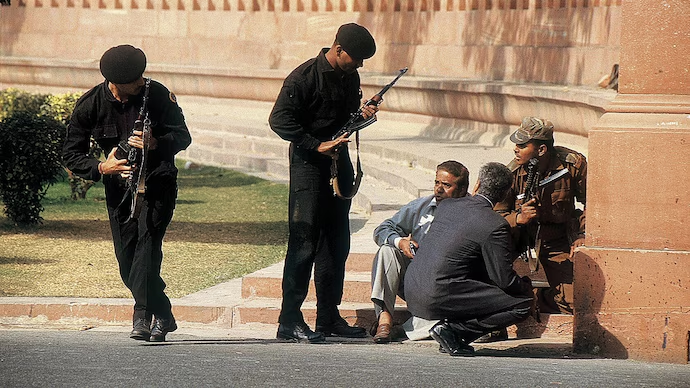
On 13th December 2001, five heavily armed terrorists later identified as members of the Pakistan-based terrorist organization Jaish-e-Mohammed (JeM) (with possible support from Lashkar-e-Taiba, LeT) stormed the Indian Parliament complex via a car carrying fake Home Ministry/Parliament stickers. They carried AK-47 rifles, hand grenades, grenade launchers, and explosive belts clearly a high-level, well-equipped suicide squad.
Their target was not just a building it was the symbolic and operational heart of Indian democracy. The attack resulted in the deaths of several security personnel, a gardener, and all five terrorists themselves.
That fact alone makes it shocking. But the deeper implication repeatedly pointed out by investigators is that this was more than an extremist terror outrage. It was a calculated strike, organised with external backing, to try to decapitate Indian democratic infrastructure.
Why This Was More Than Terror – Likely a Pakistani Covert Operation
Pakistan based Terrorists, Pakistani Shadow
The terrorists belonged to JeM (and possibly LeT was also implicated). JeM although officially banned has historically operated under the patronage or tacit support of Pakistan’s military/ intelligence structures.
Indian authorities and many analysts have asserted that this was not a random terrorist act, but one guided and facilitated by Pakistan a deliberate attempt to strike at the very core of Indian sovereignty.
The Objective: Destabilise India, Threaten Democracy
Imagine if the attackers had succeeded. Parliament invaded, MPs or ministers killed. That would have thrown the entire nation into shock, judicial and constitutional chaos, a huge vacuum of power, and a crisis of confidence in security. That, presumably, was the aim not just casualties but paralysis.
In other words, this was not terrorism alone it was hybrid warfare. By attacking the seat of Indian democracy, the mind behind the plan intended to strike at the legitimacy of India’s democratic governance.
Indian Parliament was not just a building it was India’s idea. Pakistan doesn’t just oppose India’s borders. Its military establishment opposes India’s democratic model. Pakistan was born as a military supported state. India emerged as a democratic republic. So when Pakistan targets Parliament it’s not just attacking Indian soil it is attacking the very idea of Indian governance.
The message was clear:
“If we cannot defeat your military, we will attack your democracy.”
How India Responded: Operation Parakram Mobilisation for War
Within days of the attack, the Indian government ordered its highest-level military readiness. Under Operation Parakram, India mobilised nearly half a million troops along the Pakistan border. The largest deployment since the 1971 war.
This was more than a show of force. It was a message, a response to state-sponsored terror that aggression against Indian democracy would not go unanswered. Many analysts say the mobilisation signalled India’s resolve in no uncertain terms. Operation Parakram sent Pakistan into panic mode. Islamabad thought a full-scale invasion was coming. And honestly, India was closer to war than civilians outside the military establishment still realise. The message was clear “You attack Indian democracy, we treat it as an act of war.”
But Operation Parakram also exposed a deeper strategic reality, military mobilisation alone without decisive execution and clear doctrine may not be enough to deter a persistent adversary.
Why Pakistan Relies on Such Proxy Terror Tools

For Pakistan, direct conventional conflict with India carries massive risk especially given nuclear parity and international backlash. So instead, irregular warfare and proxy militancy become tools of plausible deniability, lower cost, and psychological effect.
Groups like JeM and LeT operating from Pakistani territory are ideal instruments. Legally disowned (on paper) but functionally able to strike deep in India.
By attacking not just security forces or Kashmir, but the Parliament itself, the masterminds show that their ambition isn’t just territorial or religious it is systemic to undermine Indian democracy. Every time Pakistan faces internal pressure, the easiest escape valve is external conflict especially against India.
Thus, for Pakistan’s deep state, terror becomes a strategic lever, a way to destabilize, to keep India on edge, and to project fear rather than risk open war.
What 13 Dec 2001 Taught Us And What It Still Means
- The attack pierced the myth of “safe zones.” No place is invulnerable not even the sanctum of Indian democracy. That alone was terrifying.
- The involvement of Pakistan-backed groups shows that terrorism is often a façade for state-sponsored aggression. Democracies must recognise and counter that.
- Military response (Operation Parakram) signalled resolve but also showed the limitations of mobilization without a clear follow-up strategy. Deterrence needs more than troops at the border.
- Ultimately this was not just a crime, not just an act of violence: it was an attempt to strike at the heart of India’s identity as a democratic, rule-of-law nation.
This wasn’t a one-day event. It was a preview of the strategy Pakistan later used in
- Red Fort attack
- Akshardham
- 26/11
- Pathankot
- Pulwama
Same signature. Same ideology. Same deep state.
Also Read, ISPR: An Insight Into Pakistan’s Disinformation Machinery
Conclusion: An Attack on Democracy, Not Just on Parliament
The 13 December 2001 assault on the Indian Parliament was more than a terrorist incident it was a carefully calibrated strike, executed by pakistani terrorists but backed by a state willing to exploit proxies.
It was Pakistan’s covert war on Indian democracy. Their objective was never just bloodshed it was to shake the foundation of India’s democratic institutions.
India’s response under Operation Parakram showed determination. But the enduring lesson remains when adversaries use deniable terror as a tool of statecraft, our vigilance, intelligence, and resolve must remain stronger because at stake isn’t just security; it is the soul of our nation.


