



Hello Defence lovers! In the last part, we covered the evolution of the three CAPF -Assam Rifles, CRPF and ITBP. As India moved beyond the immediate challenges of independence, new dimensions of security began to emerge—ranging from cross-border infiltration to the protection of vital economic infrastructure. To address these challenges, the country established specialised forces with clearly defined roles and responsibilities. The Border Security Force (BSF), Central Industrial Security Force, and Sashastra Seema Bal represent this second stage in the evolution of India’s CAPFs, embodying a shift toward specialisation, technological integration, and community engagement.
1. Border Security Force (BSF)—India’s First Line of Defence (1965)

The Border Security Force was raised in 1965 in the aftermath of the Indo–Pakistan War, a conflict that exposed serious deficiencies in India’s border management and internal security framework. Before its creation, border guarding responsibilities were fragmented among state police forces and ad hoc arrangements, leading to gaps in surveillance and coordination. Recognising the strategic necessity of a dedicated border guarding force under central control, the Government of India established the BSF to serve as a permanent and professional shield along India’s vulnerable frontiers.
Initially tasked with guarding the India–Pakistan border, BSF’s mandate expanded significantly after the 1971 Bangladesh Liberation War, when it assumed responsibility for the newly formed India–Bangladesh border. Over time, the force evolved from a conventional border guarding unit into a multifaceted security organisation capable of addressing infiltration, cross-border terrorism, and transnational crime.
BSF is headed by a Director General, usually an Indian Police Service (IPS) officer, and functions under the Ministry of Home Affairs. It is organised into frontiers, sectors, and battalions to ensure effective command and control across extensive border stretches.
A distinctive feature of BSF is its multi-dimensional operational capability, supported by specialised components such as an air wing for reconnaissance and logistics, a water wing for riverine border management—particularly along the India–Bangladesh border—and artillery units that enhance its firepower during high-threat situations. This integrated structure enables BSF to operate independently as well as in coordination with the Indian Army during crises.
The primary role of BSF is border guarding and the prevention of infiltration, including the detection and neutralisation of cross-border movement by terrorists, militants, and hostile elements. The force plays a critical role in counter-smuggling operations, combating the illegal movement of narcotics, arms, counterfeit currency, and cattle across borders.
During wartime, BSF functions as a forward defence force, holding ground and supporting the Indian Army until full military deployment is achieved. In addition to security duties, BSF has repeatedly demonstrated its versatility through disaster relief and humanitarian operations, providing rescue, evacuation, and medical assistance during floods, cyclones, and other natural calamities in border regions.
In response to evolving threats, BSF has undertaken extensive modernisation initiatives. The introduction of smart border fencing, equipped with sensors and integrated command systems, has enhanced real-time surveillance and response capability. Battlefield surveillance radars and laser wall technologies have further strengthened detection along sensitive stretches, particularly in riverine and fog-prone areas.
More recently, the force has begun adopting AI-based surveillance systems, including data analytics and automated monitoring tools, to improve situational awareness and reduce human vulnerability. These technological upgrades aim to transform BSF into a technology-driven border management force.
Notwithstanding various challenges, BSF remains a cornerstone of India’s border security architecture. Its constant vigilance, operational resilience, and strategic importance have earned it the title of “India’s Peacetime Army,” standing guard at the nation’s frontiers even in the absence of open conflict.
2. Central Industrial Security Force (CISF)—Protectors of Critical Infrastructure (1969)

The Central Industrial Security Force was raised in 1969 against the backdrop of India’s expanding public sector and growing industrial base. In the decades following independence, the Government of India established large public sector undertakings (PSUs) in strategic sectors such as steel, power, mining, oil and gas, and atomic energy. These installations were critical to national development but were vulnerable to sabotage, theft, labour unrest, and external threats.
Initially, industrial security was handled by state police or private watch-and-ward arrangements, which proved inadequate for safeguarding high-value and sensitive installations. Recognising the need for a centrally controlled, professionally trained, and specialised force, CISF was created to ensure uniform standards of security across vital economic and strategic assets. Over time, its mandate expanded far beyond PSUs, reflecting the changing nature of threats to India’s economic and infrastructural security.
CISF is a specialised Central Armed Police Force functioning under the Ministry of Home Affairs and headed by a Director General, typically an IPS officer. Unlike other CAPFs that are territorially deployed, CISF follows a functional deployment model, with units stationed at specific installations across the country.
Its personnel are deployed at a wide range of critical facilities, including international airports, nuclear and atomic energy installations, metro rail networks, space research facilities, ports, power plants, and major government buildings. This diversity of deployment requires CISF personnel to be trained not only in armed security but also in access control, threat assessment, fire safety, and emergency response, making the force distinct within the CAPF ecosystem.
The core responsibility of CISF is industrial and infrastructure security, ensuring the uninterrupted functioning of assets vital to national growth and strategic capability. One of its most visible roles today is airport security, where CISF is responsible for passenger screening, perimeter security, and coordination with intelligence and aviation authorities.
In addition, CISF provides VIP and VVIP security to certain protected individuals and institutions. The force also plays a crucial role in disaster response, particularly industrial accidents such as fires, gas leaks, and explosions, owing to its specialised training in fire safety and rescue operations. Through these roles, CISF directly contributes to public safety as well as economic stability.
As threats to infrastructure have become more sophisticated, CISF has embraced extensive modernisation. At airports, AI-based passenger profiling systems and smart CCTV networks enhance threat detection and crowd management. The force has also established dedicated cybersecurity units to address digital threats to critical infrastructure, reflecting the growing importance of cyber resilience.
CISF has been at the forefront of gender inclusion among CAPFs, with the induction of women combat units, particularly in airport security roles. This not only improves operational effectiveness but also enhances passenger confidence and inclusivity.
In an era where both physical and cyber threats increasingly target economic assets, transport hubs, and digital infrastructure, CISF has emerged as a cornerstone of India’s security framework. By safeguarding the engines of growth and development, the force has become truly indispensable to India’s economic security, underscoring the expanding definition of national security in the modern age.
6. Sashastra Seema Bal (SSB)—Border & Community Force (1963)
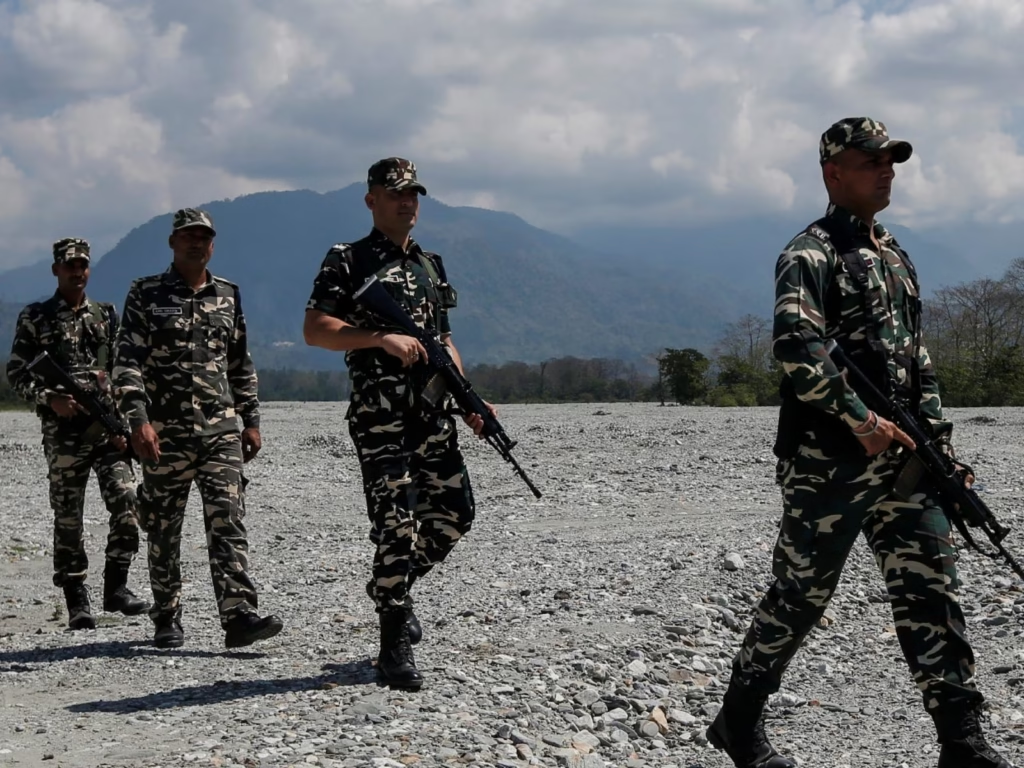
The Sashastra Seema Bal was originally raised in 1963, in the aftermath of the 1962 Sino-Indian War, as part of India’s efforts to strengthen national preparedness against external aggression. Unlike conventional security forces, SSB was conceived as a people’s resistance force, aimed at inculcating a sense of security awareness, self-reliance, and patriotism among populations living in sensitive border areas.
Its early mandate emphasised civil defence, psychological preparedness, and community engagement, particularly in border villages. However, with changing security dynamics and the growing importance of border management, SSB was later restructured and formally designated as a border guarding force under the Ministry of Home Affairs.
SSB is deployed along two strategically significant yet unique frontiers—the India–Nepal and India–Bhutan borders. These borders are characterised by difficult terrain, dense population movement, and historically open-border arrangements, especially with Nepal. The force is organised into sectors and battalions to ensure continuous presence and effective surveillance across these porous boundaries.
Unlike high-intensity borders, SSB’s structure emphasises community interaction alongside security, making it distinct within the CAPF framework.
SSB performs a range of functions that combine border security with population-centric engagement. Its core responsibilities include:
- Border guarding and surveillance, particularly to prevent trans-border crimes
- Intelligence collection, focusing on cross-border movements, organised crime, and emerging security threats
- Counter-smuggling operations, targeting narcotics, arms, counterfeit currency, and human trafficking
- Civic action programmes, such as medical camps, education initiatives, and skill development, aimed at strengthening trust and cooperation with local communities
Through this dual approach, SSB seeks to ensure security while preserving the socio-economic fabric of border regions.
SSB faces persistent challenges arising from the open nature of borders, especially along the India–Nepal frontier, which complicates the identification of illegal migrants and criminal networks. Illegal migration, smuggling, and misuse of open-border provisions by hostile elements remain key concerns. Additionally, limited technological infrastructure compared to other border forces constrains real-time surveillance and rapid response capabilities.
Modern Reforms and CAPF Transformation
In recent years, CAPFs—including SSB—have undergone significant reforms to improve efficiency and morale. Major initiatives include greater coordination and unified command mechanisms, the induction of women in combat and operational roles, modernisation of training institutions, and digitisation of personnel and service records.
The broader modernisation drive has focused on the induction of smart weapons, AI-enabled surveillance systems, integrated intelligence-sharing platforms, and improved housing, healthcare, and welfare facilities, reflecting a shift toward technology-driven and personnel-centric security management.
Conclusion
The evolution of the Central Armed Police Forces mirrors India’s own transformation—from a colonial state reliant on coercive constabularies to a modern, security-conscious nation facing complex internal and external threats. From guarding tea estates to securing borders, from riot control to counter-terrorism and infrastructure protection, CAPFs have continually adapted to changing realities. Together, they form the indispensable backbone of India’s internal security architecture, safeguarding the nation’s unity, stability, and development.
For CAPF aspirants, understanding this evolution is not just an academic exercise—it is about appreciating the legacy, sacrifice, and responsibility that come with wearing the uniform.
CAPFs are no longer auxiliary forces; they are pillars of India’s internal security architecture, standing vigilant so that democracy, development, and diversity can thrive.
From border posts and airports to industrial hubs and border villages, BSF, CISF, and SSB operate largely beyond the public spotlight. Yet their actions shape everyday security and national resilience. The next time we pass through an airport or read about border tensions, it is worth pausing to ask: how often do we acknowledge the silent role these forces play in keeping the nation secure?


