

What Would Happen If the Shimla Agreement Were Scrapped Today?


If the Shimla Agreement were formally scrapped today, very little would change on the ground for India but Pakistan would lose its last thin legal fig leaf on Kashmir, undermine its own narratives, and make escalation risks and diplomatic isolation worse, not better.
What Shimla actually does and doesn’t

Signed in July 1972 after Pakistan’s massive defeat in the 1971 war, the Shimla Agreement is a broad peace framework: respect for sovereignty, no use of force, and peaceful settlement of disputes.
Crucially, it converts the old 1949 ceasefire line in Jammu & Kashmir into the Line of Control (LoC) and commits both sides to not unilaterally alter it, while resolving all issues through bilateral negotiations rather than internationalising them.
India has treated Shimla as the legal foundation for three things:
- Kashmir is a bilateral issue, not one for UN “mediation” or foreign brokers.
- The LoC has a degree of sanctity – you don’t change it by force, you manage crises along it.
- Cross‑border terrorism is a violation of Shimla’s non‑interference and peaceful resolution clauses.
Pakistan, interestingly, plays a double game: it publicly insists Shimla does not override UN Security Council resolutions on Kashmir, and claims it still “adheres” to both, while simultaneously trying to declare Shimla “dead” when convenient.
Pakistan’s recent flirtation with “Scrap Shimla”
This hypothetical isn’t entirely hypothetical – Pakistani elites have already started talking about Shimla in the past tense.
In 2025, Defence Minister Khawaja Asif called the Simla Agreement a “dead document”, saying Pakistan was “back to the 1948 position” and disputes would now be dealt with multilaterally, i.e. via the UN and other forums.
After India’s Pahalgam offensive, Pakistan even announced it was putting Shimla and other bilateral agreements “on hold”, attempting a tit‑for‑tat after India moved to suspend the Indus Waters Treaty.
Yet within days, Pakistan’s foreign ministry quietly walked this back, stating no formal decision had been taken to revoke bilateral agreements – a classic Rawalpindi style manoeuvre: threaten to tear up the rulebook, then keep it in your pocket “just in case” you need it in court later.
This contradiction matters.
For decades, Pakistan’s own National Assembly and foreign ministry have said Shimla did not alter Kashmir’s “disputed” status but that Pakistan “continues to adhere” to both UN resolutions and Shimla.
If Islamabad now scraps Shimla, it voluntarily throws away a document it has long cited as proof that India is legally bound to engage on Kashmir bilaterally and peacefully.
If Shimla goes, Pakistan’s legal position gets weaker, not stronger
Scrapping Shimla is often presented in Pakistan’s domestic debate as “freeing” itself from bilateralism so it can take Kashmir back to the UN.
In reality, Pakistan has been going to the UN anyway – letters to UNSC presidents, calls to expand UNMOGIP, pleas for “mediation” and has repeatedly found very little appetite among major powers.
The global mood is simple:
- Kashmir is sensitive, nuclear‑shadowed, and best handled quietly between Delhi and Islamabad.
- The Shimla and Lahore frameworks are seen by many capitals as the baseline, even if they are frayed.
If Pakistan tears up Shimla, it doesn’t suddenly become more persuasive in New York or Washington; it just looks like a state that has walked away from a peace agreement it signed after losing a war. That weakens Islamabad’s credibility when it argues it is the “responsible” party seeking legal solutions, and strengthens Delhi’s case that Pakistan prefers agitation, terrorism, and grandstanding over serious negotiation.
On the ground: LoC, escalation and the terrorism problem
What about military realities?
The LoC wasn’t created by Shimla – it existed as a ceasefire line but Shimla gave it a political framework: don’t change it by force, don’t push crises beyond it, and use talks and agreements (like ceasefire renewals) to stabilise it.
Since 1972, there has been only one full‑scale conventional war between India and Pakistan (Kargil was limited), despite multiple insurgencies and terror attacks.
That stability is not because Pakistan suddenly became peaceful; it is because both sides recognised how dangerous unconstrained escalation under the nuclear shadow could be.
If Shimla were scrapped, three things would happen in the security space:
- Pakistan’s establishment would use it domestically to claim “no more constraints” – more freedom to openly talk about “bleeding India with a thousand cuts” and “mujahideen across the LoC”, which it has anyway been doing covertly.
- India would have a stronger argument to treat cross‑border attacks and LoC violations not as “Shimla violations” to be protested, but as naked aggression, giving it more diplomatic space to respond with overt military operations.
- Any future crisis – Pahalgam‑type attacks, Mumbai‑style urban terrorism – could climb the escalation ladder faster because the last big peace framework has been publicly thrown in the bin.
In other words, Pakistan’s security establishment might sell scrapping Shimla as freeing its hand; in practice, it frees India’s hand as well and India today has far more economic, diplomatic and hard‑power leverage than in 1972.
Pakistan’s “victim of Shimla” narrative vs its actual record
One of the ironies in this debate is that Pakistan complains Shimla locked Kashmir into bilateralism, yet its own record since 1972 has been to violate almost every core clause.
The agreement commits both sides to:
- Non‑interference in each other’s internal affairs.
- Settling differences “by peaceful means through bilateral negotiations”.
Pakistan’s post‑Shimla record, however, includes:
- Repeated attempts to internationalise Kashmir at the UN and other forums, directly contradicting the spirit of bilateralism.
- Sponsoring cross‑border terrorism and insurgency in J&K, from the late‑1980s militancy to Kargil intrusions and post‑2019 attacks, which is the exact opposite of “peaceful means”.
Bhutto personally assured PM Indira Gandhi that Pakistan would treat the LoC as a de facto border and not destabilise it – an assurance not written into the text, partly as a concession to his domestic politics.
Subsequent Pakistani regimes, both civilian and military, broke that political promise repeatedly, while still invoking Shimla when convenient to criticise India’s actions.
Scrapping Shimla today would therefore expose Pakistan to a simple, uncomfortable question:
If you violated the agreement in practice for decades, why make a show of revoking it now except to admit publicly what India has long argued privately?
The forgotten document Pakistan hates to mention

Back in October 1947, as Pakistani‑backed tribal raiders were closing in on Srinagar, Maharaja Hari Singh signed the Instrument of Accession, ceding Jammu & Kashmir to the Dominion of India under the Indian Independence Act.
Lord Mountbatten accepted it, Indian troops were airlifted in, and within weeks the invaders were pushed back that single legal act is what makes J&K part of India’s sovereign territory, in the same way as hundreds of other princely states that acceded in 1947.
Pakistan has never produced an equivalent instrument of accession for “POK” or Gilgit‑Baltistan its entire presence there flows from war and subsequent ceasefire lines, not from any formal consent of a lawful ruler.
When Pakistan calls Indian‑administered J&K “occupied”, it quietly skips the awkward question: occupied how, when the territory joined India through the same legal mechanism as most of the map it now recognises as “India”?
India’s part: conflict, then integration and investment

Post‑accession, India did choose a special, complicated constitutional path – Article 370, 35A, a separate state constitution but that relationship was still anchored in the original accession.
Since August 2019, after Article 370 was revoked and J&K was reorganised as a Union Territory, the Centre has gone all‑in on hard integration: national laws apply fully, and the Supreme Court has upheld the constitutional validity of this change.
The numbers tell you how Delhi is now treating J&K: from 2019 to 2023, the UT attracted around ₹81,000 crore in investment, compared with roughly ₹14,000 crore in the seven decades before- a six‑fold jump in just four years.
Prime Minister’s Development Package projects worth tens of thousands of crores, new tunnels and highways, IIT, IIM, AIIMS, expanded medical colleges, thousands of kilometres of rural roads, and record export figures for Kashmiri handicrafts have started to change the economic map of the region.
Yes, there are still serious political questions and security incidents, but even critical analyses acknowledge that J&K’s infrastructure, connectivity and public‑sector presence look very different today from the pre‑2019 era of frequent shutdowns and chronic under‑investment.
Pakistan’s part: “Azad” in name, subsidy‑riot in reality
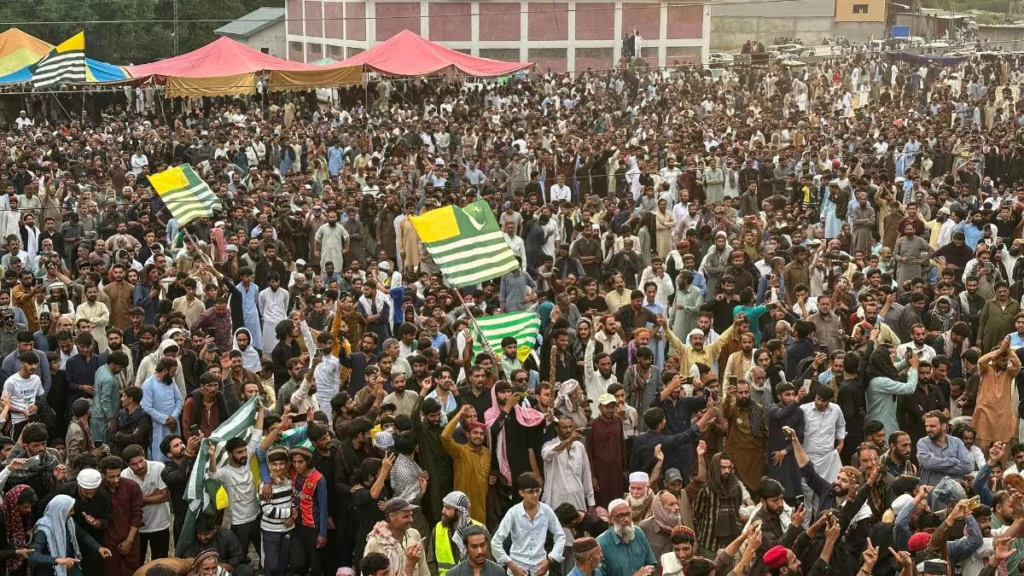
Now zoom out to Pakistan‑occupied Kashmir. In May 2024, PoJK saw one of the largest mass uprisings in their history not for “accession to Pakistan”, but against crushing electricity tariffs, high wheat prices, taxes and elite privileges.
For days, markets, schools and transport were shut; protesters blocked roads, clashed with police and Rangers, and at least one policeman and multiple civilians were killed as security forces fired teargas and live rounds.
The Joint Awami Action Committee’s demands were brutally simple: cheap electricity at local hydropower cost, subsidised flour, and an end to the perks of the political‑bureaucratic elite which lives off resources generated in the region but rarely shares them.
In places like Muzaffarabad and Neelum Valley, angry crowds beat back Rangers, tore their uniforms, raised “Azadi” slogans — and, in a scene unthinkable a decade ago, some protesters were filmed waving the Indian tricolour while demanding an end to Pakistan’s rule.
Islamabad’s response was textbook: blackout mobile and internet services, arrest dozens of activists, deploy paramilitary forces and then try to buy peace with a hurried Rs 23‑billion subsidy package once the unrest threatened to spin out of control.
Even India’s own foreign ministry, usually cautious on PoK, publicly framed the protests as “the result of policies that have deprived people of their resources,” and reiterated that Jammu, Kashmir and Ladakh are “integral” parts of India – a diplomatic way of saying: those people are rioting because Pakistan is looting a territory that legally isn’t even its own.
Put all of this together and the Shimla Agreement debate looks almost ironic.
On India’s side, you have a signed Instrument of Accession, a Supreme Court‑backed constitutional integration, and a tangible record of high public and private investment into J&K.
On Pakistan’s side, you have no accession document, a territory run through colonial‑era so called“Azad” structures, periodic communications blackouts, protests over basic bread and electricity, and visible anger at Islamabad’s resource extraction
The bottom line: who really gains?
For Delhi, a formal Pakistani exit from Shimla would be more symbolic than operational. India already treats cross‑border terrorism as a breach of Shimla and Lahore; it already rejects any UN or third‑party role and it increasingly shapes the ground reality in J&K based on its own constitutional decisions and military posture.
The real impact would be on Pakistan’s narratives:
- Loss of the ability to claim India is “legally bound” to bilateral talks under Shimla, while Pakistan both respects UN resolutions and the agreement.
- Greater difficulty persuading major powers that it is the side committed to peaceful dispute resolution, after walking away from the region’s major peace framework.
- A higher ceiling on how far India can go in response to terror or LoC violations, because the last big bilateral restraint mechanism has been publicly discarded.
In that sense, if Shimla were scrapped today, it would not “liberate” Pakistan diplomatically or militarily it would mainly expose that for fifty years, Islamabad has wanted the benefits of a peace agreement it never truly honoured and now wants to escape the costs by pretending the document never mattered in the first place.


