

Tibetan Uprising Day: From Lhasa Revolt To India-China Border Faultline


Every year on 10 March, Tibetans across the world mark Tibetan Uprising Day, remembering the 1959 revolt in Lhasa against Chinese rule and the brutal crackdown that followed. For Tibetans it is a day of grief and resistance, but for India it has also become a reminder of how decisions taken in the 1950s and 2003 on Tibet helped create the very India- China border crisis New Delhi now struggles with.
What Happened In Lhasa In 1959
On 10 March 1959, tens of thousands of Tibetans surrounded the Norbulingka palace in Lhasa after rumours spread that Chinese authorities planned to detain or harm the 14th Dalai Lama during an official event. The crowd turned into a human shield, refusing to let him attend the Chinese programme and turning a protective gathering into an open revolt against Chinese rule.
Within days, Tibetan fighters and civilian militias were battling the People’s Liberation Army in and around Lhasa as Chinese forces used artillery and infantry to crush the uprising. Exile accounts speak of thousands of deaths and heavy shelling of monasteries and neighbourhoods, effectively ending organised resistance in central Tibet.
Flight To India And The Birth Of Exile Tibet
As the crackdown intensified, the Dalai Lama fled Lhasa in disguise and after a dangerous journey across the Himalayas, entered India with a small entourage. India granted him asylum first in Tawang, then in Dharamshala where he set up the Central Tibetan Administration (CTA), which functions as a government‑in‑exile and political voice for many Tibetans.
The shock of 1959 turned Tibet from a closed, high‑altitude society into a global cause that could speak directly to foreign publics, parliaments and media. Tibetan Uprising Day thus became both a memorial for those killed and a permanent reminder that Tibet’s political status and human rights situation remain unresolved.
How Tibetan Uprising Day Looks Today

On every 10 March, Tibetan communities and supporters hold marches, sit‑ins and cultural events in India, Europe, North America and beyond. Protesters wave Tibetan flags, carry portraits of the Dalai Lama and speak about political prisoners, language rights and environmental destruction on the plateau.
In Rome, for example, the 64th anniversary saw hundreds of Tibetans and Europeans marching through the city and hosting an event in the Italian Senate to highlight abuses and launch a cross‑party parliamentary group on Tibet. Similar actions in Dharamshala, Delhi, London and Washington aim to push governments to raise Tibet in their dealings with Beijing and at the UN.
Beijing’s Story: “Feudal Rebellion” And “Liberation”
China tells a completely different story about 10 March. Official narratives describe the 1959 events as a “feudal rebellion” by a small clique around the Dalai Lama, claiming that the PLA’s victory “liberated” Tibetan serfs and allowed modernisation. Chinese state media and white papers present Uprising Day as a milestone in completing national unification and abolishing “theocratic feudalism.”
On the ground, this narrative justifies dense security, checkpoints and heavy surveillance, including big‑data policing and AI‑assisted monitoring of monasteries and border regions. Around sensitive dates like 10 March, authorities routinely pre‑empt gatherings and online activity by detaining monks, writers and community leaders seen as potential organisers.
From Streets To Cyberspace: Digital Repression And Resistance
Over the last two decades, Tibetan leaders, NGOs and media have been hit by sustained waves of targeted cyberattacks phishing, spyware, and hacking campaigns that security researchers often trace back to Chinese state‑linked actors. The goal is to read emails, map networks and disrupt transnational activism before it can mobilise protests or lobbying.
In response, groups like Tibet Action Institute train activists in encryption, secure communication and counter‑surveillance, turning Tibetan Uprising Day into a moment not just of street protest but also of coordinated online campaigns. Hashtags, livestreams and digital art try to puncture Beijing’s imagery of a “happy, harmonious Tibet” and reach younger audiences worldwide.
Also Read, Tibet’s Silent Cry: How China is Erasing an Ancient Civilization
India’s Central Role: Host, Neighbour, Stakeholder
India sits at the heart of Tibetan Uprising Day because it hosts the Dalai Lama, the CTA and the largest Tibetan exile population and because what happened to Tibet directly reshaped India’s northern frontier. For decades, India’s official line has been cautious: recognise Tibet as part of China on paper, while quietly giving space to Tibetan politics and culture at home, with occasional restrictions when ties with Beijing are sensitive.
But repeated clashes on the Line of Actual Control, Chinese renaming games in Arunachal and the approaching question of the Dalai Lama’s succession are forcing a rethink of how deeply Tibet is baked into India’s China problem. Tibetan Uprising Day has become an annual test of how much public and diplomatic space New Delhi is willing to give Tibet in the shadow of its China relationship.
Panchsheel: When India First Recognised “Tibet Region Of China”
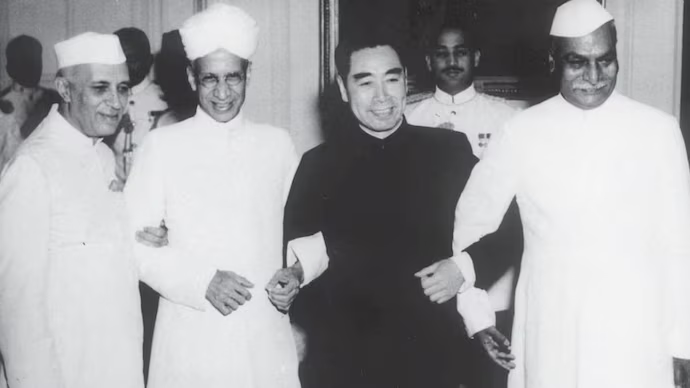
The biggest turning point was the 1954 Sino‑Indian Agreement, or Panchsheel Agreement, formally titled the “Agreement on Trade and Intercourse Between the Tibet Region of China and India.” This was the first time independent India explicitly accepted Tibet as the “Tibet Region of China,” moving away from the earlier British‑era approach that treated Tibet as a separate negotiating partner.
Crucially, the agreement dealt with trade routes and pilgrimage, listing passes along the India–Tibet frontier but never actually delimiting the India–China boundary. In hindsight, it allowed Beijing to consolidate its claim over Tibet while giving India no reciprocal, clearly accepted border, leaving ample room for disputes later in Ladakh and Arunachal Pradesh.
Vajpayee’s 2003 Step: Recognising The TAR
A second key move came in 2003, when the Vajpayee government explicitly recognised the Tibet Autonomous Region as part of the territory of the People’s Republic of China. This went further than the 1954 formula by endorsing Beijing’s formal administrative category, tightening India’s legal alignment with China’s position on Tibet.
Strategic commentators argue that this deeper recognition narrowed India’s space to question Chinese control over Tibet or to clearly tie Tibet to the border dispute, even as Beijing refused to accept the McMahon Line or India’s claims in (China Occupied Ladakh) Aksai Chin. India gained some process‑oriented assurances and mechanisms on the boundary, but no final settlement and those same sectors later saw stand‑offs like Doklam and Galwan.
“We Never Had A Border With China Until Tibet Fell”
Historians and Tibetan exile writers point out that in 1947 India’s northern neighbours were Tibet and Xinjiang, not the PRC as we know it today. The 1914 Simla Convention and McMahon Line, agreed between British India and Tibet (with China present but refusing to ratify), defined the eastern boundary with Tibet, while treating Tibet–China relations as a separate question.
When the PLA took Tibet in 1950 and India later recognised the “Tibet Region of China,” the buffer disappeared and, for the first time, Indian territory directly touched Chinese‑controlled highlands. Analysts describe this as transforming a civilisational frontier mediated through a Buddhist kingdom into a hard front line against a centralised, communist great power in the Himalayas.
New Candour From India’s Top Leadership
What used to be mainly a historian’s or exile critique is now being echoed at the highest official levels. In February 2026, Chief of Defence Staff General Anil Chauhan stated publicly that India’s border dispute with China arose after India recognised Tibet as part of China in 1954 through Panchsheel. He stressed that India assumed the agreement had effectively settled the frontier, while China treated it as a limited trade deal and never saw it as fixing the boundary.
External Affairs Minister Dr. S. Jaishankar has also said that the 1954 “peaceful coexistence” arrangement over Tibet is “very difficult to understand today,” signalling that New Delhi now sees those concessions as having given away leverage without securing enforceable commitments from Beijing. Together, these statements amount to an official admission that India’s Tibet decisions helped create the very border problem it now faces.
Rethinking Tibet: From “Closed Chapter” To Strategic Lever
Recent Indian analyses argue that Tibet can no longer be treated as a closed chapter but must be seen as a live variable in India’s China strategy. They highlight Tibet as a lost buffer, a water tower feeding major Asian rivers and a key factor in the military balance in the Himalayas.
Policy papers call for moving from “strategic silence” to “strategic assertion”: building Tibet expertise into the security establishment, engaging more visibly with the Central Tibetan Administration and developing a “One Tibet” narrative that stresses Tibet’s distinct history to counter Beijing’s “One China” framing. Many suggest using Tibetan Uprising Day each year as a coordinated diplomatic and narrative tool with parliamentary events, expert briefings and calibrated statements to quietly remind the world that Tibet’s status and its militarisation remain central to India’s security.
Why Tibetan Uprising Day Matters For India’s Future
Seen through this lens, Tibetan Uprising Day is not only about remembering a 1959 revolt; it is also about understanding how the loss and recognition of Tibet transformed India’s map and threat environment. It is a yearly chance for India and other democracies to contest Beijing’s story, keep Tibet on the global agenda and signal that stability in the Himalayas is impossible while Tibet remains locked down and over‑militarised.
For India, the line is stark: India did not share a direct border with China until Tibet fell and until New Delhi accepted that fall on paper. Tibetan Uprising Day is the day when that strategic mistake first exploded on the streets of Lhasa, and when India’s Himalayan future quietly began to change.


