



Modern wars are often explained through visuals: missiles launching, tanks advancing, aircraft taking off in perfect formation. Firepower dominates headlines because it is visible, dramatic, and easy to sell. Logistics, by contrast, is invisible and therefore underestimated.
Yet history is consistent on one uncomfortable truth: armies rarely lose wars because they lack weapons, they lose because they cannot move, supply, repair, or sustain those weapons.
A tank without fuel is not a weapon.
A missile without spares is not deterrence.
An army without logistics is a countdown.
What Logistics Really Means (And Why Most People Get It Wrong)

Logistics is often misunderstood as “supply.” In reality, it is far broader and far more decisive.
Military logistics includes:
- Fuel supply and storage
- Ammunition availability and transport
- Spare parts and repair cycles
- Food, water, medical support
- Transportation networks (road, rail, air, sea)
- Maintenance manpower
- Time — the most limited resource in war
Firepower decides how hard you can strike. Logistics decides how long you can fight. Wars are endurance contests disguised as shock events.
Why Firepower Wins Battles But Logistics Wins Wars

Firepower creates tactical advantage. Logistics determines whether that advantage can be sustained.
Many armies look overwhelming in the opening days of war. Precision strikes land, formations advance, morale appears high. But as days turn into weeks, friction accumulates:
- Equipment breaks
- Ammunition stocks thin
- Fuel convoys become targets
- Maintenance backlogs grow
- Troops tire
At this point, logistics becomes the battlefield. The side that planned for endurance survives. The side that planned for spectacle fades. Good logistics enable rapid maneuver, offensive operations, and the ability to concentrate forces at decisive points. Poor logistics force armies into a defensive posture, reduce operational tempo, and surrender the initiative to more logistically capable enemies.
The 2022 Russian invasion of Ukraine demonstrates this principle with painful clarity. Russian forces advanced rapidly initially, but overextended supply lines and poor logistical coordination meant fuel ran out, tires failed due to poor maintenance, and logistical units lacked protection. The resulting inability to maintain momentum allowed Ukrainian forces to regroup, counterattack, and ultimately prevent Russian forces from capturing Kyiv. What might have been a rapid Russian victory was prevented not by Ukrainian tactical brilliance alone, but by Russian logistical failure to sustain operations. Conversely, the U.S. military’s success in the 2003 invasion of Iraq was enabled in part by extraordinary logistical capabilities that allowed rapid advance and sustained offensive operations across vast distances. The contrast between the two invasions one failing due to logistical collapse, one succeeding partly due to logistical excellence illustrates the principle vividly.
When Logistics Failed, Even With Superior Weapons
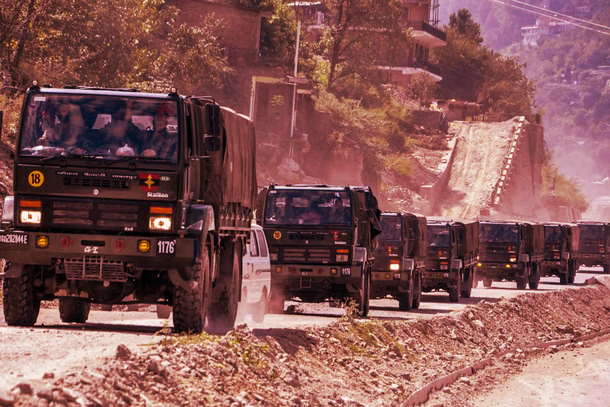
History offers repeated examples of militaries entering wars with impressive arsenals and still failing.
Firepower Without Fuel Is Illusion
Modern mechanised forces consume enormous resources. A single armoured brigade burns fuel at a rate that would shock civilian planners. Aircraft require not just fuel, but specialised maintenance, ground crews, and spare parts.
If supply lines stretch too far or become contested:
- Vehicles are abandoned
- Aircraft sortie rates collapse
- Units become static targets
No weapon system can outrun its logistics tail.
Logistics Is the First Target in Modern War

Modern militaries understand this reality which is why logistics is often the first target, not the last.
Precision strikes increasingly focus on:
- Fuel depots
- Ammunition storage
- Bridges and rail hubs
- Maintenance facilities
- Supply convoys
Destroying combat units is slow and costly. Disrupting logistics creates collapse indirectly and faster. An army that cannot resupply must either retreat or stop fighting. Drones, long-range missiles, and intelligence, surveillance, and reconnaissance (ISR) systems have extended the range at which supply lines can be attacked. Previously “safe” rear areas are now within range of stand-off weapons. The Russia-Ukrainian war has demonstrated how modern weaponry including drone swarms and long-range artillery can systematically disrupt logistics across multiple domains, forcing adaptation of tactics and operations.
Why Large Armies Suffer More From Logistics Than Smaller Ones
There is a common belief that bigger armies are stronger. Logistically, the opposite is often true.
Large forces:
- Consume more resources
- Require longer supply chains
- Depend on centralized hubs
- Become less flexible
Smaller, professional forces with:
- Efficient logistics
- Decentralized supply
- Rapid repair capability
often outperform numerically superior adversaries over time. Quantity amplifies logistics problems. Quality mitigates them.
The Pakistan–China Illusion: Hardware Without Sustainment

Pakistan and China both project military strength heavily through hardware – aircraft numbers, missile ranges, tank inventories. What is discussed far less is sustainment under pressure.
Pakistan’s Constraint
Pakistan’s military relies heavily on:
- Imported fuel
- Foreign spare parts
- External maintenance support
- Limited strategic depth
In prolonged conflict, these dependencies become vulnerabilities. Even well-equipped units face degradation once supply lines are stressed or interdicted.
China’s Scale Problem
China’s strength in numbers creates its own logistical burden:
- Massive fuel demand
- Long internal supply routes
- Heavy reliance on rail and fixed infrastructure
- Centralized control systems
So, Scale impresses in exercises. Scale strains in war.
Why Logistics Punishes Poor Doctrine
Doctrine decides how logistics is used.
Rigid command systems:
- Delay resupply decisions
- Over-centralize control
- Discourage initiative at lower levels
Flexible doctrines:
- Empower unit-level logistics decisions
- Allow improvisation
- Adapt routes and methods dynamically
A bad doctrine turns logistics into a bottleneck. A good doctrine turns it into a force multiplier.
Also Read, The Myth of ‘Battle-Tested’ Weapons
Why Democracies Often Do Logistics Better Than They Fight
This may sound counterintuitive, but democracies often outperform authoritarian systems in logistics over long wars.
Why?
- Transparent procurement systems
- Strong civilian industry integration
- Redundant supply chains
- Accountability for failure
Authoritarian systems may move fast initially, but they struggle to adapt when plans fail and in war, plans always fail. Logistics rewards honesty more than ambition.
India’s Quiet Advantage: Planning for the Third Month of War
India’s military posture is often criticised as cautious or slow. In reality, it reflects an understanding that India is unlikely to fight short, decisive wars.
India’s strategic environment involves:
- Difficult terrain
- Long borders
- Multiple potential fronts
- Escalation management
This forces a logistics-first mindset:
- Stockpiling over spectacle
- Infrastructure development
- Redundancy over optimization
- Gradual force employment
India prepares less for the opening headline and more for the phase when wars usually turn.
Why Wars Are Lost Long Before the First Shot
Logistics failures are rarely sudden. They are baked in years earlier:
- Underfunded maintenance
- Overpromised capabilities
- Ignored supply vulnerabilities
- Unrealistic war timelines
When war begins, these decisions reveal themselves brutally. By the time the shooting starts, the outcome is often already constrained by logistics.
Conclusion –

Firepower captures attention. Logistics determines survival. Weapons win moments. Logistics wins time. And in war, time is the only resource that cannot be replenished. Armies that plan for endurance outlast armies that plan for display. Nations that invest in logistics quietly usually discover that they never needed to shout about power in the first place.
Logistics decide wars because they are the physical manifestation of strategy. A brilliant operational plan means nothing if armies lack the supplies to execute it. Tactical victories mean nothing if supplies cannot be replenished. Superior weapons and personnel cannot fight without ammunition and fuel.
Always remember,
Wars are not decided by how hard you strike on day one, but by whether you can still strike on day thirty.


