



India’s intent to be a global defence export leader is no longer a fantasy—it’s transpiring before our eyes. Supported with expansive reforms, an emerging industrial sector, and a national goal for self-reliance, defence exports have skyrocketed in the last decade—growing by 35 times.
The challenge now goes beyond the numbers. In order to take the lead, India truly needs to get from quantity to quality—cutting-edge systems, with global standards, dependable systems, unloading, and robust after-sales support. This needs dismantling of bureaucratic bottlenecks and heavy investments in foundational research and development, areas in which progress is still patchy.
This export boom is not just an economic opportunity; it is a strategic lever. India is emerging as a trusted partner in defence cooperation, which is helping shift and deepen geopolitical influence. The long-term strategy depends on a crucial shift, however: achieving operational excellence and global trust through the translation of industrial growth.
Section 1: The National Mandate: From Dependence to Dominance
The Aatmanirbharta and Make in India Framework: Policy and Vision
Exporting military equipment from India is not just a business opportunity; it is of strategic significance to the country. The government has organised this shift under the “Make in India” and “Aatmanirbhar Bharat” (Self-Reliant India) initiatives, which provide the central policy and ideological foundation for the shift.
Defence Minister Rajnath Singh has on many occasions expressed that self-reliance in defence is not just cutting down imports, “it is creating an ecosystem where Indian industry, both public and private, evolves to world-class capability and becomes a global supplier of high-quality defence products.”

This fundamentally repositions the national strategy and aligns the pursuit of self-sufficiency from inwards looking to globally aspirational.
In support of this vision, a set of crucial policy enablers has been put in place. The government has relaxed FDI policies, permitting up to 74% investment through the automatic route and up to 100% via the government route, specifically to draw in foreign investment and advanced technology. The release of five “positive indigenisation lists” has propelled this agenda forward by requiring 509 platforms, systems, and weapons to be produced exclusively in India.
This guarantees a landlocked market with a steady demand for local industry. The creation of two Defence Industrial Corridors in Uttar Pradesh and Tamil Nadu complements this policy by attracting investment and building a strong industrial foundation. Defense reforms illustrate a fundamental shift in government policy. Instead of continuing to rely on a protectionist model, India is seeking global partnerships to develop a globally competitive indigenous ecosystem with export capabilities. This approach transforms the local manufacturing mandate into a global competitive edge.
Quantitative Leap: Metrics of Transformation
The change in policy has led to extraordinary advances in the defence sector in India. The past ten years have seen defence exports multiply in value by about 35 times. From ₹686 crore in FY 2013-14, the value of these exports have drastically increased to around ₹23,622 crore (or US$2.8 billion) in FY 2024-25. During the same period, domestic defence production has more than tripled, going from ₹40,000 crore in 2014 to over ₹1.5 lakh crore in FY 2024-25, and is expected to reach nearly ₹2 lakh crore by this year.

Despite the impressive biologics of these metrics, they invite some critical examination and deeper contextual understanding. Although a 35-fold increase is quite an accomplishment, it is sourced from a very low base and has not yet facilitated India’s entry into the ranks of the top global arms exporters. Even with an export budget of $2.8 billion, it is still a small portion of the country’s own defence budget, which stands at nearly $93 billion. India has demonstrated the ability to compete in the global export market, but has not yet attained the scale necessary to be considered a global superpower in this industry.
As the country moves beyond a steep growth curve to take on large-scale exports, fresh challenges are bound to emerge around quality control, production scale, and stiff global competition. The government’s specialty continues to be setting targets, which this year stand at ₹30,000 crore and, quite optimistically, at ₹50,000 crore by 2029. These are clear indicators of the government’s awareness of how much work still lies ahead.
Section 2: The Evolving Ecosystem: A New Architecture for Defence
Catalyzing a Private Sector Revolution
A key pillar of India’s defence transformation is the strategic integration of its private sector. This industry segment has seen a rising contribution to total defence production, reaching 22.56% in FY 2024-25.
In India’s naval and land systems advanced infra development, Larsen & Toubro (L&T) emerged as one of the most notable firms to contribute. The chairman of L&T acknowledged the firm’s efforts with mobile bridges and other land systems. He also acknowledged Hanwha, the South Korean member, as an “essential partner” in the success of the K9 Vajra self-propelled gun.

In terms of naval systems, L&T builds parts for strategic submarines and offshore patrol vessels. Similarly, Bharath Forge of the Kalyani Group shifted their business focus from automotive components to defence. With the Advanced Towed Artillery Gun System (ATAGS), which the company developed with DRDO, it has one of its major products representing a unique, homegrown capability. The company also has export achievements in sending 100 artillery guns to other countries, one of which is Armenia. Tata Advanced Systems (TASL) augments India’s export achievements by cooperating with global aerospace leaders such as Boeing and Lockheed Martin to produce vital accessories for the AH-64 Apache helicopter and the C-130J transport.
Even with the positive changes, there is still a significant contradiction between operational realities and the mission objectives. In order to help private industry, the Indian government has decided to allocate 75% of the public procurement budget to Indian-run companies. But private firms still face intense competition from state-run companies. The chairman of L&T pointed out that contend with five public sector ship construction/repair yards for naval contracts increases the difficulty of obtain orders. The competitive landscape remains heavily influenced by the history of DPSUs and OFs. The government’s recent attempts to push for the corporatisation of the Ordnance Factory Board is a move in the right direction; but without a more pronounced change in the entire operational approach towards current businesses, tapping into the complete potential of the private sector will continue to stall the country’s aim to enhance competitiveness.
R&D and Innovation as Core Drivers
The DRDO is the backbone of the national defence apparatus of India, being the main research and development entity tasked with producing contemporary weaponry for both public sector and commercial production.

The Innovations for Defence Excellence (iDEX) and Acing Development of Innovative Technologies with iDEX (ADITI) initiatives by the government are looking to encourage new and vibrant technologies with the DRDO participating. These schemes create a platform and give grants to MSMEs and even start-ups to come up with new technologies in various bleeding-edge sectors such as artificial intelligence, quantum technology, autonomous systems and more.
Underinvestment in fundamental research and development significantly hampers the current roadmap to technological self-reliance. The government stresses innovation, yet it allocated only 3.94% of the overall defence budget to the Defence Research and Development Organisation (DRDO) for the fiscal year 2025–2026. This meagre allotment highlights a glaring paradox in terms of having intentions to do something and actually doing it. In the absence of generous research and development funding, India will be compelled to fall back on other countries to provide essential “deep tech,” vital solutions.
India has displayed an outstanding achievement in the field of military aviation by associating with Safran from France to develop and manufacture a jet engine for the Advanced Medium Combat Aircraft (AMCA). This partnership is a response to an indigenous deficit in a crucial technological area. In the absence of such collaborations, India has a technologically strong innovative skill set and it is only a matter of making the proper investment in innovation.
Section 3: Flagship Exports and Strategic Partnerships: A Case-Based Analysis
Missile Diplomacy: The BrahMos and Pralay Case Studies
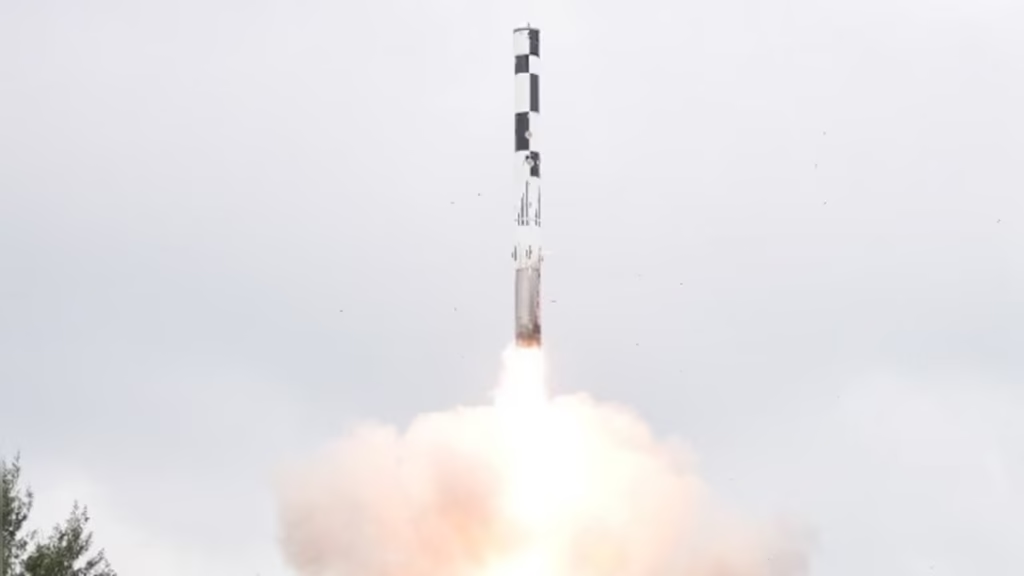
Having realised the full potential of the BrahMos supersonic cruise missile system, India had numerous lucrative deals. One of the most significant ones is the $375 million deal with the Philippines over the sale of three BrahMos missile batteries—not only is it a lucrative deal, but it is also a brilliant strategic move. Unlike other regional missile exports, BrahMos showcases India’s competence in research and manufacturing. This deal is not just any other agreement. It provides hope to a country, the Philippines, where China is gradually taking over, and helps empower a smaller ally and, in the grand scheme of things, the region.
Moreover, the sale of the BrahMos to the Philippines not only pays heed to the broader geopolitical balance but has unmeasurable importance as well. It equips the Philippines with the ability to counter China’s aggressive posturing in the South China Sea, which gives India the ability to enhance security in the wider Indo-Pacific region. However, countries do not treat such deals like general commercial agreements or trade diplomacy; instead, they pursue them as acts of evolving ‘missile diplomacy,’ where a nation designs military technology to defend a region’s interests and restructure its security geometry as a particularly astute geopolitical initiative.
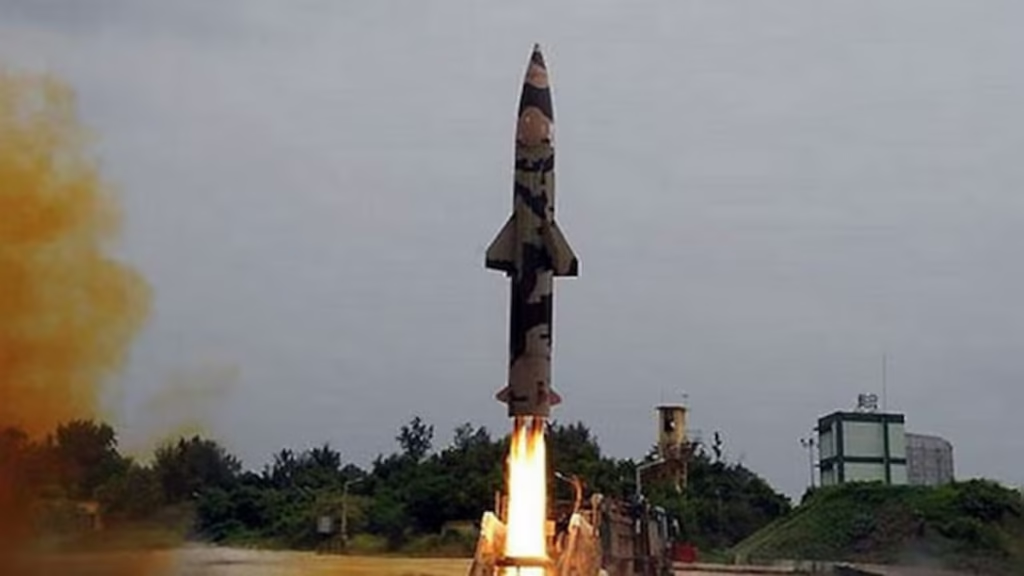
On the subject of military technology, it allows for other exports as well. As a matter of fact, other countries from the Association of South East Asian Nations (ASEAN) and the Middle East are showing their interest in partnering with the BrahMos. The Philippines government is eyeing a more enhanced military technology from the Indian government, specifically the procurement of the Pralay tactical ballistic missile. The procurement will allow the nation to address threats emerging from the ASEAN and also collaborate with India more deeply in the defence sector. Expansive and coordinated military technology collaborations are at the forefront of their international policy.
Articulation of Firepower: The ATAGS and Pinaka Successes
India’s arms exports are not limited to advanced missile systems; the country has been successful in exporting a variety of military equipment. India signed contracts with Armenia to export ATAGS (Advanced Towed Artillery Gun System) and the PINAKA multiple rocket launchers, which demonstrated India arms export capabilities and its ability to act in a global vacuum. In Russia’s absence, India and France have replaced Russia as Armenia’s arms supplier; their offers to Armenia enabled the country to pivot from their relation with Russia due to their failure to support Armenia during the Nagorno-Karabakh War.

Armenia’s army appreciated the features of the first 12 ATAGS guns which India and France jointly designed. The features like mobility, reliability, and long-range precision of these guns stood out amongst other artillery. For this reason, Armenia ordered 80 more ATAGS which could be delivered in Armenia and the Indian company agreed to another set of national requirements for this batch.

This deal is a milestone in India’s reliability and flexibility as an emerging supplier, filling up a critical gap left by the limitations of other exporters. This success of ATAGS, coupled with India’s consistent support for Armenia on geopolitical issues like Kashmir, positions the sales as a strategic win that establishes India’s role as a dependable alternative to major powers.
The Tejas Factor: Potential and Obstacles
The LCA Tejas, a symbol of India’s self-reliant aerospace capabilities, serves indicating the country’s ability to export its technology. The Indian Air Force, through substantial acquisition of 180 of the Mark 1A variant, has paved the way for mass production, generating interest from countries like Argentina, Egypt, Nigeria, and Malaysia.
However, the Tejas is a stark reminder of a crucial, twisted issue that India’s defence production industry faces: its heavy reliance on foreign-origin components. A British arms embargo nearly scrapped the Argentine deal by impacting several Tejas components, most notably the Martin-Baker ejection seat. The Tejas is a “Made in India” aircraft, with over 65% of its components being indigenous, but it is astonishing that, with one small part affected, India could lose a billion-dollar contract, something very few of us would expect. This situation again exposes the fact that while India may have the platform and the frame, other advanced countries have the exportable technology.

India co-develops a new jet engine with France as a straightforward response to its need, but until it truly indigenizes such technologies, its export plans will remain hostage to the political sensitivities of its technology partners.
Section 4: Strategic Significance and Geopolitical Outlook
The defence industry has deep strategic importance for India when seeking to export. Beside many other advantages, lowering the reliance historically placed on foreign suppliers to offer it mission-critical platforms and technology also offers India a chance to practice substantive control over its strategic policy. Before taking such avenues of action, enterprises gear their business models to protect the revenue stream to similar government contractors, fueling a system that discourages innovation due to its dissociated processes. India shifted its approach by considering locally made arms, tipping the assumption that while producing technologies, the country would resort to buying the local products, moving them to another scale, and turning refused products compliant.

India assumes this new position in the world by expanding both old and new partnerships. It provided the Philippines with security services that were unbelievable ten years ago (the Marawi battle is a good example). We entered into arms deals with the Philippines and Armenia purely for money and contraband sales, but these deals also support our well-heeled military, improve national security, and prevent the use of denied resources, thereby setting up a global attitude and military driver.
Section 5: Multi-layered Recommendations for a Decisive Future
To support defence export aspirations, Indian policy has to focus on fostering the development of bureaucratic transparency, allowing this bureaucracy to support the aspirations of the private sector. India makes the process of procurement for both the private sector and government far less efficient compared to its potential. The export authorisation system of the country is too opaque and slow. Lowering the bureaucratic hurdles in the export approval process and simplifying compliance documentation can drastically improve export authorisation.
Secondly, far-reaching reforms are required in the procurement and export administration. First, the system and the structures need to be digital. Several layers of the ministry review exports and defence procurement in India and ratify documentation at every step—a process now completed easily online. Additionally, the Defence Acquisition Procedure (DAP) should gear its entry-level processes towards indigenous companies at the outset, enabling them to integrate directly into the system. This would make a significant difference to the credibility of India as a defence as well as an export supplier.
India must also cultivate a culture of public and private sector partnerships, with policy changes acting only in concert to enforce a level playing field between the DPSU’s and private sector. Prescribing order quotas and committing to public-private partnership guidelines are only the first steps to real public-private collaboration, states the report. India must adopt a change in approach to procurement and set the tone for public and private sectors to partner by walking the talk.
Lastly, the country must address product reliability and after-sales support. A well-established system must support shipment and post-delivery activities for all exported platforms. A single unit failure can damage a country’s reputation and affect years of export effort. Building a positive exported products image would require consistent effort, and it helps project the country as a dependable supplier in an ever-low margin global market.


